
Every CNC machined part starts as a piece of raw material — a bar, a plate, a tube — and you pay for all of it, including the part that leaves as chips. A few choices at the drawing stage decide how much of it you buy. Here's how to design to standard stock sizes instead of against them.
You're buying the stock, not the part
CNC machining shops don't buy metal to your dimensions. They buy bar stock, plate, and tube in standard shapes and standard sizes. Round bar, for example, is normally on the shelf in whole-millimeter diameters, or in the US on the eighths of an inch. Anything in between is either a special order or the next size up with the difference machined away.
So two things about your part drive its machining cost before a tool touches it: which shape it starts from, and which size.
Rule 1: finish just under a stock size
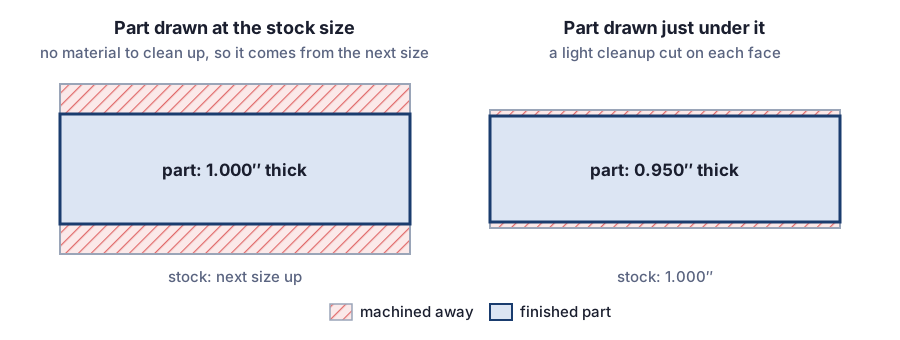
A machined face needs material to clean up. If your part is exactly 1.000″ thick and both faces are machined, it can't come from 1.000″ stock — there's nothing left to cut — so it comes from the next size up, and you pay for the extra metal and the time to remove it.
Draw the same part at 0.950″ and it comes from 1.000″ stock with a light facing cut. Taking fifty thousandths off a face is cheap. Buying and machining down an oversize block is not.
Rule 2: leave the stock surface alone where you can
Cold-finished bar is accurate as delivered. A standard 1-inch cold-drawn steel round holds its diameter within a few thousandths of an inch. If an outside diameter or a bar width isn't a fit surface, dimension it at the stock size and say the stock surface is acceptable. That face then costs nothing to machine, because nobody machines it.
One catch: the mill tolerance on cold-finished bar usually runs under size, not over. Don't put a plus-only tolerance on a surface you want left as stock. It's the same discipline as specifying only the tolerance the part needs.
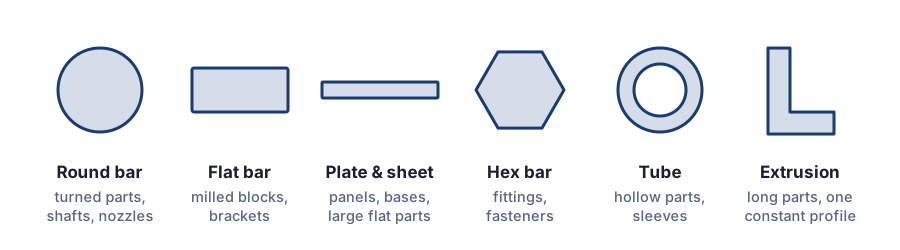
Rule 3: start from the shape closest to the part
Start from tube
The bore is already there. You machine the features, not the hole through the middle.
Start from hex bar
The wrench flats come with the stock, so there's no milling operation to cut them.
Consider an extrusion
A custom die typically runs from a few hundred dollars for a simple solid shape to a few thousand for a hollow one.
Extrusions come with a condition: mills commonly set a minimum run, often 500 to 1,000 pounds. That makes a custom profile a production decision, not a prototype one. When it fits, 6063 is the usual alloy — see our materials library.
Inch drawings, metric stock
Stock sizes follow the country. US metal yards mostly stock inch sizes; shops in metric countries stock millimeter sizes. The mismatch is a known source of waste: a 25 mm drawing filled with 1-inch bar means extra lathe passes to remove 0.4 mm nobody planned for.
It runs the other way when an inch-dimensioned part is made overseas. A 1.000″ diameter is 25.4 mm, and 25 mm bar is 0.4 mm too small, so the part comes from a larger bar and gets turned down. If that diameter isn't critical, tell us — a small change on the drawing can drop the part into a standard metric size.
What to tell your shop
1. Which surfaces can stay as stock. Every one you release is an operation that doesn't happen.
2. Which dimensions have room to move. A non-critical thickness or diameter can shift to the nearest stock size.
3. How many you'll need over time. That decides whether tube, hex, or a custom extrusion is worth setting up.
Not sure what your part should start from?
Send us the model. Every quote includes a founder-reviewed DFM check — we'll flag the dimensions that are costing you a size of stock before you commit to production.
Get a Free Quote →