
Floats, tanks, buoys, housings — if your part is hollow and plastic, there's a good chance it will be rotomolded or blow molded. The two processes make similar-looking parts with opposite economics. Here's how we choose between them, and which plastic to spec once the part lives in a pond, the ocean, or a pool.
Two ways to make a hollow part
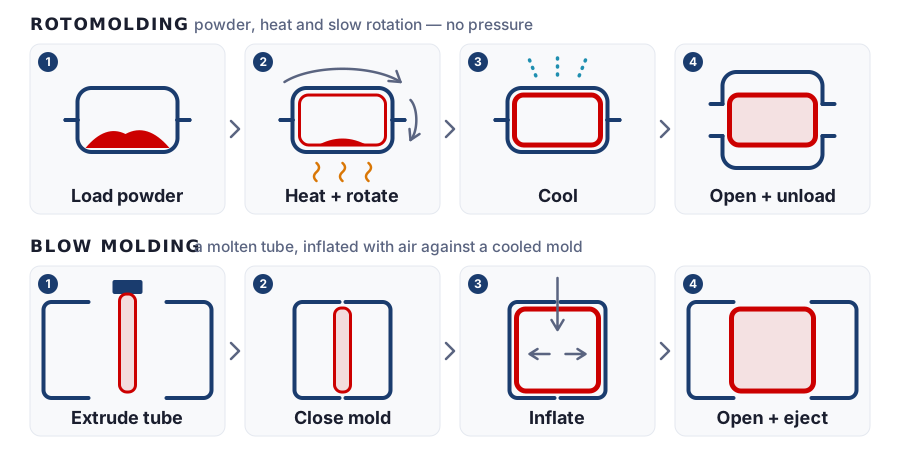
Rotational molding loads plastic powder into a hollow mold, then turns the mold slowly on two axes inside an oven. The powder melts and coats the inside of the mold; the mold is cooled, opened, and the part comes out. Nothing is under pressure, so the molds are simple — cast aluminum or welded sheet metal — and cost a fraction of what a comparable blow mold does. The price of that simplicity is time: a cycle runs half an hour or more.
Blow molding extrudes a tube of molten plastic, closes a mold around it, and inflates the tube with air against the cooled mold walls. It's fast — cycles are typically under a minute — which is why it owns bottles and other high-volume containers. The mold has to take clamp force and carry cooling, so the tooling costs several times more.
Volume decides first
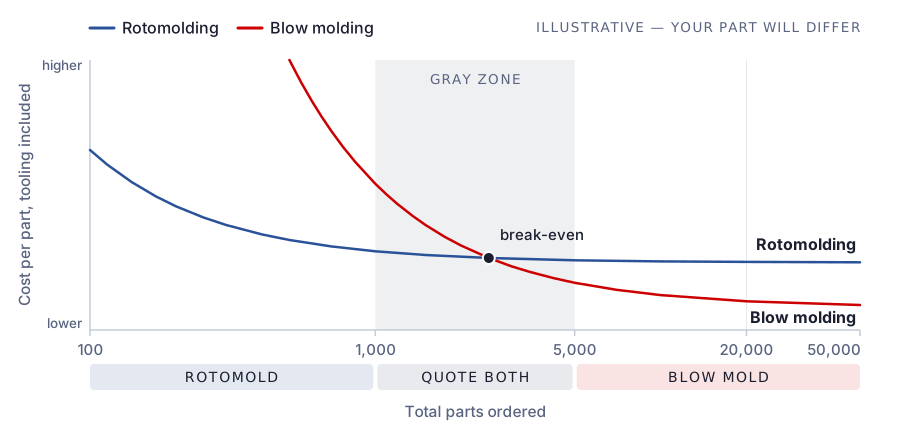
Rotomolding is low tooling and a higher price per part. Blow molding is the reverse. So the first question is the same one that decides CNC versus injection molding: do you make enough parts to pay off the more expensive mold?
Under ~1,000 parts
Rotomolding almost always wins. The mold is cheap, and a design change later doesn't mean scrapping an expensive tool.
~1,000 – 5,000 parts
It depends on the part. Worth quoting both ways before you commit to either mold.
5,000+ parts
Blow molding usually wins, and the bigger the run, the bigger the gap. Fast cycles drive the piece price down.
Treat those bands as a starting point, not a law. Published break-even figures for these two processes run anywhere from about 3,000 parts to 20,000, because the answer moves with the part:
— Part size. A bigger part means a bigger, costlier blow mold, so rotomolding stays competitive longer.
— Lifetime volume, not the first order. 800 parts once is a rotomolding job. 800 parts a year for six years is worth a blow-molding quote.
— How settled the design is. A rotomolded wall is set by how much powder goes into the mold, so you can thicken it without touching the tool.
What the part itself tells you
Sometimes the geometry settles it before volume gets a vote.
| If your part… | Lean toward | Why |
|---|---|---|
| Is large — several feet across | Rotomolding | Size is rarely the limit. The same process makes kayaks and 20,000-gallon tanks. |
| Needs thick walls or tough corners | Rotomolding | Walls run from 1/32″ up to 1″, and material naturally builds up at the outside corners. |
| Needs molded-in inserts or foam fill | Rotomolding | Metal inserts mold in as part of the cycle, and the hollow can be foam-filled. |
| Has to hold a consistent wall | Rotomolding | Blow molding stretches a tube, so the wall thins where it stretches furthest. Rotomolding holds roughly ±10%. |
| Is small, thin-walled, high-volume | Blow molding | This is what the process was built for: fast cycles, light walls, low piece price. |
One more point for rotomolding on parts that carry load for years: because nothing is forced into the mold under pressure, the parts come out virtually stress-free.
A real one: the 28-inch float
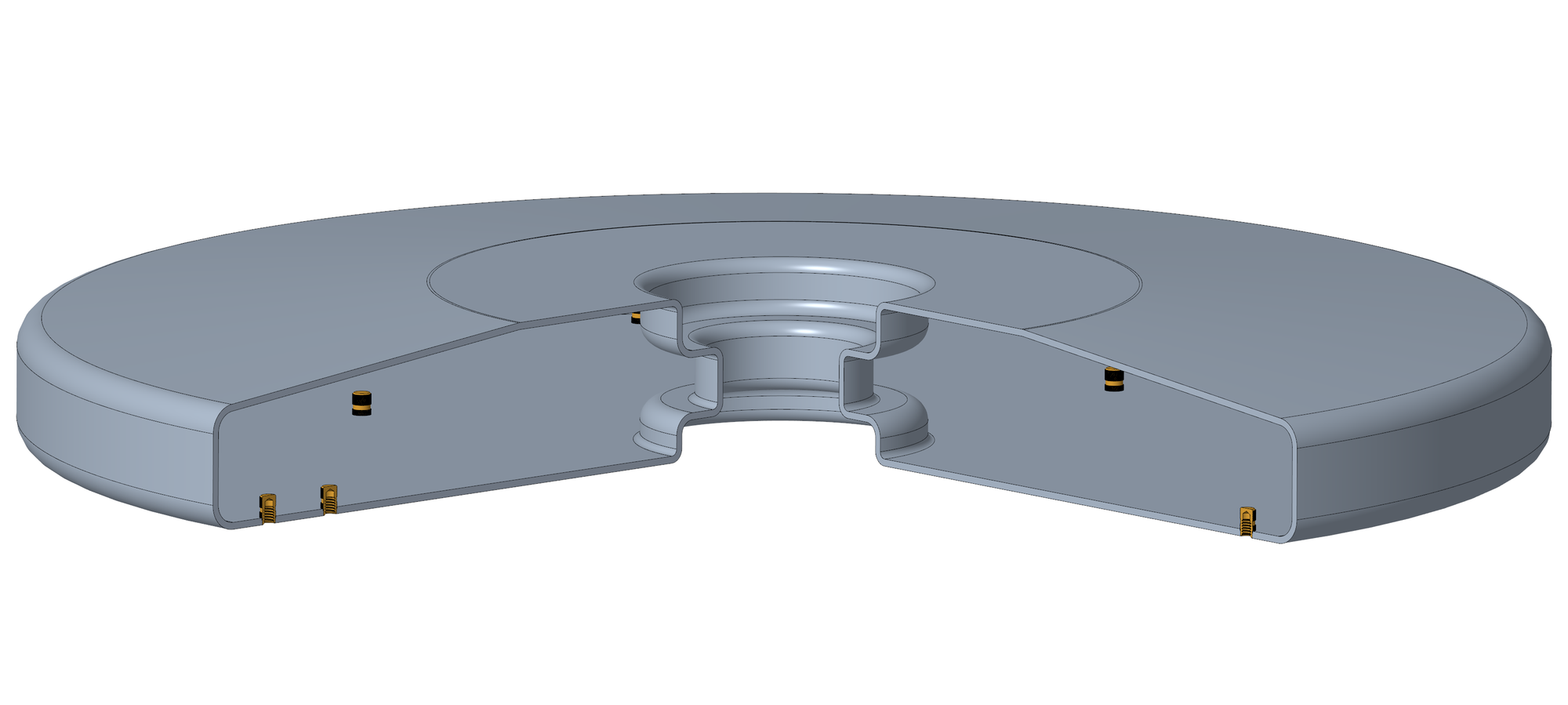
A fountain-equipment customer needed a float: a hollow disc 28 inches across and 3 inches thick, in black UV-stabilized polyethylene with a wall just over 3/16 inch thick, a center opening, and eleven brass threaded inserts for mounting hardware. Quantity: about 200.
That's a short conversation. At 200 parts the mold decides it: a rotomold costs a fraction of a blow mold for a part that size, and 200 parts can't pay the difference back. The inserts go in with the cycle too: placed in the mold, they come out as part of the float. Rotomolding was the clear call.
The same float at 5,000 a year would be a different conversation — and we'd quote it both ways.
The process picks the resin. The water picks the additives.
For parts like these, both processes run polyethylene, in different forms. Rotomolding uses powder grades: most often LLDPE (linear low-density polyethylene), which is tough, good in the cold, and highly resistant to stress cracking, or a stiffer medium- or high-density grade when the part has to hold its shape. Blow-molded industrial parts are typically HDPE. Either way, polyethylene absorbs almost no water and doesn't care whether that water is fresh or salt.
What changes with the environment is the additive package — so tell your supplier exactly where the part will live.
Sun is the enemy
Spec a UV-stabilized grade. Resin makers rate UV packages by hours of accelerated weathering: UV-8 (8,000 hours) is the usual outdoor baseline, with UV-15 and UV-20 above it. Carbon black adds protection and hides algae film between cleanings.
Salt attacks the hardware
Polyethylene is rated fully resistant to seawater — commercial dock floats use the same UV-stabilized LLDPE on lakes and at the coast. What salt corrodes is metal: spec 316 stainless for inserts and fasteners.
Chlorine is slow, not sudden
Polyethylene is rated resistant to sodium hypochlorite — pool chlorine — at concentrations far above pool water. Over years it uses up the resin's antioxidants, so ask for a well-stabilized grade.
Be wary of switching a hollow outdoor part to polypropylene for chemical resistance: it oxidizes more readily than polyethylene and loses impact strength in the cold.
Get the package right and 10 to 15 years outdoors is a realistic design target — commercial rotomolded dock floats carry 12- to 15-year warranties. For the metal parts that bolt to the float — nozzles, brackets, fasteners — see our guide to floating-fountain components.
The 30-second decision
Ask three questions in order:
1. Under about 1,000 parts — or large, thick-walled, or still changing? → Rotomold it.
2. Small, thin-walled, and needed by the tens of thousands? → Blow mold it.
3. Somewhere in between? → Quote both.
Either way, put the environment on the drawing: fresh, salt, or chlorinated water, and how much sun.
Have a float, tank, or housing to build?
Send a CAD file, a drawing, or the part itself. Every quote includes a founder-reviewed DFM check — we'll tell you which process fits your volume before you commit a dollar to tooling. More on our rotational molding service.
Get a Free Quote →